
Trust is one of those words we use constantly in
leadership. It’s usually spoken about in
the abstract: “we need to build a high-trust culture,” and “leaders need to be
trustworthy.” This is all true but we
also need to talk about what trust actually looks like in practice, how fragile
it really is, what it actually takes to repair when trust is broken.
Trust Is Not Built in Grand Gestures
Leaders often think about building trust through big visible actions like the town hall where they're "transparent," the away day where everyone bonds, the all-staff email about the company's direction. These things have their place. But they are not where trust is actually built.
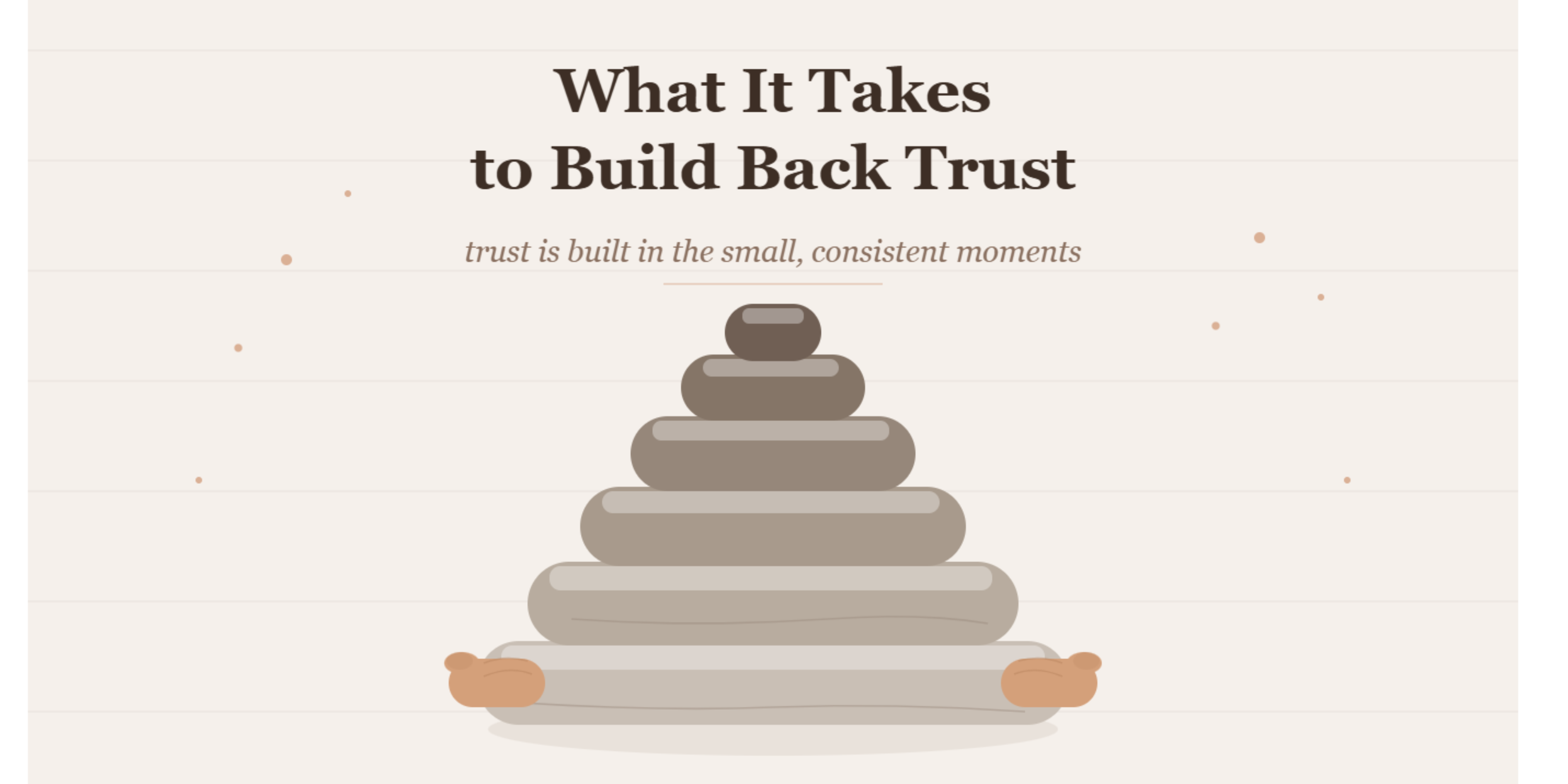
Trust is built in the small, consistent moments. It's built when you say you'll follow up and you actually follow up. When someone flags a concern and you don't dismiss it. When you give credit where it's due in the moment, not six months later in a performance review. When your behaviour on a bad day looks roughly similar to your behaviour on a good day.
Leaders who are most trusted by their teams are rarely the most charismatic or the most senior; they're the most consistent. Their teams know what they'll get. And that predictability and reliability is the foundation of trust.
Consistency is, in many ways, the most underrated leadership
skill there is.
What Actually Breaks Trust
Trust erodes in predictable ways, even if the specific circumstances vary.
Broken commitments. Not necessarily broken promises. I mean the quieter version: the feedback that was promised and never arrived, the decision you said you'd revisit that you never came back to, the open door that turned out to be more closed than advertised. These accumulate and people stop expecting. And when they stop expecting, they've stopped trusting.
Inconsistency. When the rules don't seem to apply to everyone equally. When one person is held accountable and another isn't. When the leader who talks about psychological safety shuts someone down in a meeting. The gap between what is said and what is done is where trust goes to die.
Being left out of decisions that affect you. People don't expect to be consulted on everything. But when a significant change lands in their lap without any context or conversation and when they find out from the grapevine before they find out from you, it signals that they're not important enough to be in the loop. That stings, and it lingers.
Confidentiality breaches. Someone shared something with you in confidence and it got out. Whether you meant it to or not is almost beside the point. The damage is the same.
None of these are necessarily malicious. Most are the result
of leaders moving too fast, carrying too much, or simply not paying close
enough attention to the ripple effects of their actions. Which is why this
isn't really a conversation about good and bad leaders. It's a conversation
about attentiveness.
The Hardest Part: Repairing Trust
First: you have to actually acknowledge what happened specifically, not vaguely. "I know things haven't been easy lately" is not an acknowledgement. It's avoidance dressed up as empathy. What broke trust was something specific. The repair needs to be specific too.
Second: your words carry less weight now than they did before the breach. You have to act your way back into trust, repeatedly, over time, without demanding that people recognise you're trying. The rebuilding is quiet work.
Third: some people will take longer than others. Leadership teams often make the mistake of thinking that once something has been addressed, it's resolved. But people process at different speeds and with different histories. Someone who has been let down before will take longer to extend trust again.
And fourth: sometimes the breach was serious enough that
trust cannot be fully restored in that relationship. Part of leadership
maturity is knowing the difference between a trust gap that time and consistent
behaviour can close, and one that has fundamentally changed the nature of the
relationship.
A Question for You
In my coaching work, I often ask leaders: Who trusts you, and how do you know?
It sounds like a simple question. Most leaders, when they sit with it honestly, realise they've been assuming trust rather than earning it. They mistake the absence of visible conflict for the presence of trust. They confuse compliance with confidence.
There may be people on your team who go quiet in meetings, who bring you the polished version of everything but never the messy middle, who say "fine" when you ask how things are going. They may not distrust you but they probably don't fully trust you either. And there's a lot of space between those two things.
Trust exists on a spectrum, and it shifts constantly based on experience. The question isn't "do my people trust me?" as if it has a permanent answer. The question is "what am I doing, right now, to make trust a reasonable response to working with me?"
What This Looks Like in Practice
There are a few things I come back to consistently with leaders who are working on this:
Slow down on commitments. Say less and mean more. Every "I'll get back to you on that" that disappears is a small withdrawal from a trust account. If you're not sure you can do something, say so. "Let me think about whether that's possible" is more trustworthy than "absolutely" followed by silence.
Close the loop even when the answer is no or when nothing has changed. A brief "I haven't forgotten this, and here's where it stands" does more for trust than most leaders realise.
Notice who isn't speaking. In your meetings, in your one-on-ones, in your organisation. Silence is often data. It's worth asking what it might be telling you.
Be the same person in the corridor as you are in the boardroom. Trust lives in the informal moments as much as the formal ones.
Trust is about how you show
up, day after day, in ways that are mostly unremarkable and almost never
celebrated. That's what makes it hard and it's what makes it
worth paying attention to.